When exploring solar energy options, the choice between monocrystalline and polycrystalline panels arises frequently. Consumers often wonder, "What is the difference between monocrystalline and polycrystalline panels?" Understanding this distinction is crucial for informed decision-making. Monocrystalline panels are made from a single crystal structure, resulting in higher efficiency and a sleek appearance. These panels typically perform better in low-light conditions and have a longer lifespan.
In contrast, polycrystalline panels are composed of multiple crystal structures, which can result in a less uniform look. They are usually less expensive to produce. However, they may demonstrate lower efficiency and performance under certain conditions. Choosing the right type hinges on both budget and energy needs.
Ultimately, one's choice may reflect personal priorities—whether it be aesthetics, cost, or efficiency. Some buyers may overlook the impact of these differences on long-term energy savings. Engaging with energy professionals can help clarify these nuances, ensuring a selection that's well-suited to individual circumstances and expectations.
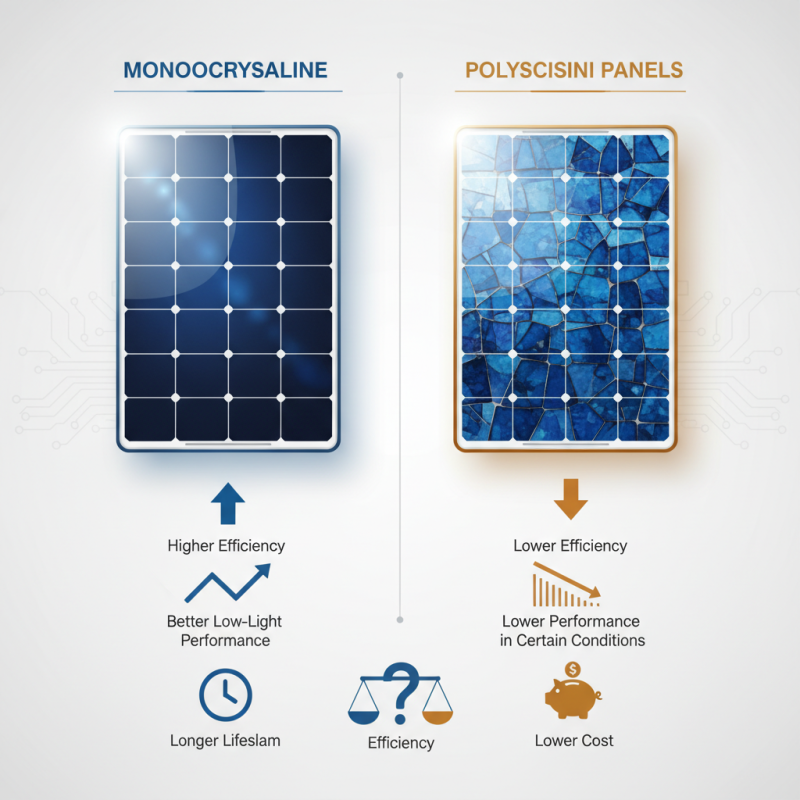
Understanding Solar Panels: Monocrystalline vs. Polycrystalline
Solar panels are essential for harnessing renewable energy. Among the available options, monocrystalline and polycrystalline panels stand out. Each type has unique characteristics impacting efficiency and cost.
Monocrystalline panels, made from a single crystal structure, tend to offer higher efficiency rates. According to the National Renewable Energy Laboratory, these panels can achieve efficiencies of 15-22%. Their sleek black appearance also appeals to many homeowners. However, they are more expensive to produce. The complex manufacturing process leads to higher upfront costs.
On the other hand, polycrystalline panels consist of multiple crystal structures. Their manufacturing is simpler, making them less expensive. Efficiency rates typically range from 13-16%, based on data from industry reports. While they are more budget-friendly, their blue hue may not appeal to all. Polycrystalline panels can also occupy more space for the same power output.
Understanding these differences is crucial. It helps consumers make informed choices. Each panel type has pros and cons. Potential buyers must weigh efficiency against cost. This decision impacts both immediate investments and long-term energy savings.
What is the Difference Between Monocrystalline and Polycrystalline Panels?
| Feature |
Monocrystalline Panels |
Polycrystalline Panels |
| Efficiency |
15% - 22% |
13% - 16% |
| Cost |
Higher |
Lower |
| Lifespan |
25 years or more |
20 - 25 years |
| Temperature Tolerance |
Better performance in high temperatures |
Lower performance in high temperatures |
| Space Efficiency |
More efficient, requires less space |
Less efficient, requires more space |
| Aesthetics |
Uniform black appearance |
Bluish hue with a speckled appearance |
Composition and Structure: How Monocrystalline and Polycrystalline Panels Differ
Monocrystalline and polycrystalline solar panels differ significantly in their composition and structure. Monocrystalline panels are made from a single crystal structure, typically silicon. This allows for a uniform appearance and generally higher efficiency. They have a sleek dark color and rounded edges. However, this uniformity also makes them more expensive to produce. The purity of the silicon contributes to their efficiency but raises costs.
Polycrystalline panels, on the other hand, are made from multiple silicon crystals. This results in a speckled blue hue and a less uniform appearance. The manufacturing process is simpler and less costly, which typically leads to lower prices. However, this can come at the expense of efficiency. The multiple crystal structures can create barriers to electron movement, impacting performance, especially in low-light conditions.
Each type has its advantages and trade-offs. It's crucial to consider factors like space and budget. The choice between them ultimately rests on individual needs and conditions. Some may find that the higher efficiency of monocrystalline panels justifies the cost. Meanwhile, others might opt for polycrystalline options due to affordability. Understanding these differences helps in making informed decisions for solar energy solutions.
Comparison of Monocrystalline and Polycrystalline Solar Panels
Efficiency Comparison: Energy Conversion Rates of Each Panel Type
When comparing monocrystalline and polycrystalline solar panels,
efficiency plays a crucial role. Monocrystalline panels typically offer higher energy conversion rates, often exceeding 20%.
This is due to their uniform structure, which allows electrons to flow more freely. In contrast, polycrystalline panels
usually range from 15% to 17% efficiency. The difference in efficiency stems from the manufacturing process.
Monocrystalline panels are made from a single crystal structure, while polycrystalline panels consist of multiple crystal fragments.
While monocrystalline panels are generally more efficient, they come at a higher cost.
The investment may not always be justified for all users. Polycrystalline panels, despite their lower efficiency, can be a more budget-friendly option.
However, their performance might falter in low-light conditions.
This contrast highlights the importance of considering one's energy needs and budget.
It’s essential to reflect on your specific situation. If space is limited, investing in higher-efficiency panels might be wise.
In larger spaces, polycrystalline panels could suffice. Both panel types have strengths and weaknesses related to installation, temperature tolerance, and aesthetics.
Evaluating these factors can guide your solar energy choice.
Cost Analysis: Pricing Trends for Monocrystalline vs. Polycrystalline Panels
Monocrystalline and polycrystalline solar panels present unique cost dynamics. Monocrystalline panels typically have a higher upfront cost, averaging around $1,000 to $1,500 per panel. Their efficiency rates can reach up to 20% or more. This increased efficiency means you may need fewer panels to generate the same power as polycrystalline panels, which are cheaper, averaging $800 to $1,200 each but usually operate at around 15-17% efficiency.
Pricing trends have shown that the gap between these two types is narrowing as technology advances. According to the Solar Energy Industries Association (SEIA), the cost of solar technology has dropped by about 82% since 2010. In this climate, while polycrystalline panels remain the budget-friendly option, there is a growing appeal for the long-term savings found in monocrystalline systems due to their better space efficiency.
Yet, mixed feelings persist regarding which option truly offers more value. Some consumers may find initial savings tempting but may overlook the long-term efficiency gains. A study from the National Renewable Energy Laboratory (NREL) indicates that better efficiency can lead to reduced installation costs in constrained spaces. Reflections vary widely in the solar community, and individual energy needs ultimately dictate the best choice for diverse situations.
Applications and Suitability: Best Uses for Monocrystalline and Polycrystalline Panels
Monocrystalline and polycrystalline solar panels serve different needs in the renewable energy landscape.
Monocrystalline panels excel in space-limited environments due to their high efficiency, typically ranging from 15% to 22%. Their sleek design makes them visually appealing, often suited for residential rooftops. On the other hand, polycrystalline panels average around 13% to 16% efficiency. They are ideal for larger installations where space is not a constraint, such as commercial and industrial applications.
Research indicates that monocrystalline panels perform better in low-light conditions. This characteristic makes them suitable for regions with less sunlight. Polycrystalline panels, while generally less efficient, have lower production costs. They are often chosen for utility-scale projects that prioritize affordability over space or aesthetics. According to a recent report by the Solar Energy Industries Association, nearly 45% of solar installations in 2022 utilized polycrystalline panels due to their cost-effectiveness.
Despite their advantages, each type has drawbacks. Monocrystalline panels can be more expensive initially, which may deter some consumers. Conversely, polycrystalline panels may require more space, potentially limiting their accessibility for homeowners. Evaluating specific energy needs and site conditions is essential for choosing the right panel type. Understanding these considerations ensures informed decisions in solar panel applications.
FAQS
: The main types are monocrystalline and polycrystalline panels.
Monocrystalline panels can achieve efficiency rates of 15-22%.
They require a complex manufacturing process, leading to higher production costs.
Polycrystalline panels typically have efficiency rates of 13-16%.
Monocrystalline panels are sleek and black, while polycrystalline panels are blue.
Yes, they can be budget-friendly, but their output may need more space.
Polycrystalline panels may perform worse in low-light compared to monocrystalline panels.
Consider your energy needs, budget, and available space for installation.
It depends on your specific situation and energy requirements.
Yes, evaluating both aspects can guide a more satisfying choice.
Conclusion
The article titled "What is the Difference Between Monocrystalline and Polycrystalline Panels?" delves into the fundamental characteristics that set these two types of solar panels apart. Monocrystalline panels are made from a single crystal structure, which generally allows for higher efficiency and a more compact design due to their better energy conversion rates. Conversely, polycrystalline panels, made from multiple crystal fragments, tend to be less efficient but are often more cost-effective, making them a popular choice for budget-conscious consumers.
Furthermore, the article discusses the applications and suitability of each panel type, highlighting that monocrystalline panels are ideal for space-constrained environments where efficiency is crucial, while polycrystalline panels serve well in larger installations where cost is a top priority. In summary, understanding these differences is key for determining the best solar solution to fit specific energy needs.
 Zylo Solar
