Zylo Solar
Before buying batteries, many homeowners ask, “What capacity of energy storage do I need for my house?” The answer depends on more than monthly electricity use. It depends on your essential appliances, outage length, solar production, and evening demand. A refrigerator, Wi-Fi router, medical device, and several lights may need modest capacity. Electric heating, water heating, or vehicle charging can change the calculation quickly.
Kelly Speakes-Backman, a recognized energy-storage leader and former CEO of the Energy Storage Association, described storage as “the Swiss Army knife of the electric grid.” Her comparison is useful because one battery can serve different purposes. It can reduce evening grid purchases, provide backup power, or capture extra solar energy at noon. However, each purpose requires different sizing. Capacity measures stored energy in kilowatt-hours. Power measures how much electricity the battery can deliver at one moment. Confusing these figures causes expensive mistakes.
Start with real observations. Check your utility bills, inverter data, and appliance labels. During a summer evening, note whether the air conditioner runs continuously. During an outage, imagine the sound of a silent freezer and the inconvenience of a dead router. Then separate essential loads from optional comforts. My first estimate may be wrong. Weather, battery aging, and unusual household habits can shift the result. A qualified installer should verify the design using local solar conditions and manufacturer data. Oversizing wastes money, while undersizing creates disappointment. The practical goal is not the biggest battery. It is dependable energy for the moments your household truly cannot lose.
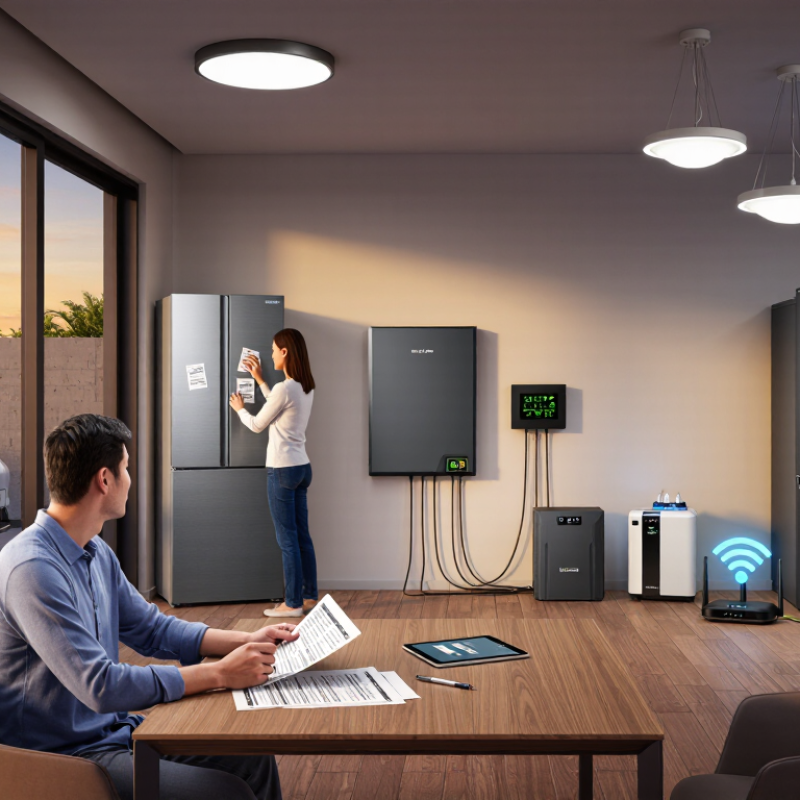
Home energy storage capacity means the amount of electricity a battery can store, measured in kilowatt-hours (kWh). It is different from power, measured in kilowatts (kW). Capacity determines how long essential appliances can operate. Power determines how many appliances can run simultaneously. The U.S. Energy Information Administration reported average residential electricity use of about 886 kWh per month in 2023, or nearly 30 kWh per day. However, a household rarely needs to back up every device.
A practical calculation starts with essential loads. A refrigerator, router, several lights, and a medical device may consume 5–8 kWh overnight. A 10 kWh battery may provide less usable energy after reserve limits, temperature effects, and conversion losses. Its real output could be closer to 8 kWh, depending on system settings. The National Renewable Energy Laboratory’s 2024 Annual Technology Baseline also treats storage sizing as a balance between energy capacity, power rating, efficiency, and operating conditions. Bigger is not always better.
Think about a winter evening with cloudy weather. Solar panels may recharge slowly, while heating equipment demands more power. Capacity should match your critical loads, outage expectations, and solar production. It should also reflect future changes, such as an electric vehicle or heat pump. Calculations can be imperfect. Household behavior is less predictable than a spreadsheet. Checking hourly electricity data gives a more realistic estimate than relying on monthly averages.
Sizing a battery begins with your actual electricity use, not a guess. The U.S. Energy Information Administration’s 2020 Residential Energy Consumption Survey reported average household use of about 886 kWh per month. That equals roughly 29 kWh daily. Your home may differ greatly. Heating, cooling, cooking, and electric vehicles can change the result.
List the appliances you need during an outage. Record each appliance’s wattage and expected daily runtime. Use this formula:
watts × hours ÷ 1,000 = daily kWh
Add the loads together, then multiply by the number of backup days. Include a 15–25% buffer for inverter losses, cold weather, and unexpected usage.
For example, 10 kWh of essential daily loads may require 12–12.5 kWh of usable storage for one day. NREL’s energy storage research stresses that usable capacity and power output must be evaluated separately. A battery may store enough energy but still struggle with a high starting surge.
Tips: Review twelve months of utility bills. Mark your highest-use month. Separate essential circuits from comfort loads. Check continuous and peak power ratings. The EIA average is only a reference, not a personal target. This estimate remains imperfect. Appliance labels can also mislead. Measure real consumption when possible, then revisit your calculation after seasonal changes.
Why Do I Need to Know My Home Energy Storage Capacity?
During a power outage, storage capacity becomes a countdown clock. Capacity is measured in kilowatt-hours, while output power is measured in kilowatts. A battery may hold 10 kWh but still struggle with a large starting load from a pump or refrigerator. That difference matters at 2 a.m., when the house is dark and the temperature is falling. The U.S. Energy Information Administration reported that American customers experienced about six hours of power interruptions in 2023, including major events. Longer outages can happen after storms, wildfires, or equipment failures.
Make a simple emergency load list. A refrigerator might use roughly 1–2 kWh daily, while lights, internet equipment, and phone charging may need another 0.5–1 kWh. A small heating device can consume several kilowatt-hours within a few hours. A 10 kWh battery will not deliver all 10 kWh to appliances because conversion losses and reserve settings reduce usable energy. My first estimate was too optimistic. Real homes are less predictable.
Professional planning should use measured consumption, not guesses. The National Renewable Energy Laboratory’s energy-storage research emphasizes evaluating both duration and peak demand. For example, a 5 kW load running for four hours needs about 20 kWh before losses. During an outage, homeowners may need to choose between heating, cooking, and preserving food. Keep a reserve for overnight needs. Capacity still cannot predict everything. Cloudy weather, cold temperatures, battery age, and unexpected medical equipment loads can change the result.
Knowing your home energy storage capacity helps explain real energy costs and daily system performance. Capacity is measured in kilowatt-hours, or kWh. It shows how much energy the battery can store, but the usable amount is usually lower. Reserve settings, conversion losses, and battery age reduce available power.
In a typical home assessment, I compare storage capacity with evening demand. A household using 8 kWh after sunset may need more than an 8 kWh battery. Some energy remains reserved, and the inverter also consumes a small amount. A larger system can reduce electricity purchases during expensive hours. However, oversizing can increase the upfront cost without improving savings. It may also leave stored energy unused during mild weather.
Capacity affects performance during cloudy days and outages too. A smaller battery may discharge quickly when several appliances run together. A larger unit can support longer operation, if its power rating is also high enough. Capacity and output power are different measurements. This distinction is often missed.
My first estimate was too optimistic. I counted rated capacity instead of usable capacity. That mistake changed the expected payback period. Accurate planning requires recent electricity bills, seasonal usage, and local rate schedules. Review those figures with a qualified installer or energy professional. Real homes are unpredictable. A child may use a heater, or guests may add unexpected demand. Leave some margin, but question every extra kWh.
| Nominal Storage Capacity | Usable Capacity 90% depth of discharge |
Approximate Backup Duration 8 kWh/day critical load |
Annual Energy Delivered 250 cycles |
Estimated Annual Energy-Cost Offset $0.15/kWh price difference |
Typical Performance Effect |
|---|---|---|---|---|---|
| 5 kWh | 4.5 kWh | About 13.5 hours | 1,125 kWh | About $169 | Suitable for essential loads such as refrigeration, lighting, internet equipment, and selected outlets. |
| 10 kWh | 9.0 kWh | About 27 hours | 2,250 kWh | About $338 | Can cover a full day of critical loads and shift more solar or low-cost electricity into evening use. |
| 15 kWh | 13.5 kWh | About 41 hours | 3,375 kWh | About $506 | Provides longer outage coverage and greater flexibility for evening demand, subject to inverter power limits. |
| 20 kWh | 18.0 kWh | About 54 hours | 4,500 kWh | About $675 | Offers extended backup and high energy-shifting potential, but may be underused if household demand is low. |
Why Do I Need to Know My Home Energy Storage Capacity?
Choosing the right storage capacity starts with real household demand, not a calculator alone. The U.S. Energy Information Administration reported average residential electricity use of about 10,800 kWh in 2022, or nearly 30 kWh daily. Your home may use far less. Heating, cooling, and electric water heating can change the result sharply.
List your essential loads, such as a refrigerator, lights, internet equipment, and medical devices. Record their wattage and daily operating hours. Then check your evening demand, when solar generation usually falls. A practical starting point is one day of essential electricity, plus a reserve for cloudy weather. Remember usable capacity. A 10 kWh battery may deliver less after depth-of-discharge limits and conversion losses. The National Renewable Energy Laboratory’s Storage Futures Study stresses that power rating and energy duration serve different purposes. A battery may store enough energy but still struggle with a high starting surge.
Tips: Review twelve months of electricity bills. Measure large appliances separately. Ask for usable capacity, continuous output, surge output, warranty limits, and round-trip efficiency. Avoid sizing only for your highest bill; that can create unnecessary cost. I have seen neat spreadsheets fail when a heat pump starts suddenly. Real homes are imperfect. Leave room for changing habits, future appliances, and one uncomfortable question: which loads truly need backup? Sources: U.S. Energy Information Administration, Residential Electricity Data, 2022; National Renewable Energy Laboratory, Storage Futures Study.
Capacity is measured in kilowatt-hours, or kWh. It shows how much energy a battery can store. Usable capacity is usually lower. Reserve settings, conversion losses, and battery age reduce available energy.
Start with essential household demand, especially after sunset. A home using 8 kWh each evening may need more than 8 kWh. Keep some energy reserved. Real homes vary.
List refrigerators, lights, internet equipment, medical devices, heating, cooling, and water heating. Record each appliance’s wattage and daily operating hours. A heater can change the estimate quickly.
No. A 10 kWh battery may deliver less energy after reserve limits and conversion losses. Battery age can reduce it further. Check the usable figure.
Not by itself. Capacity measures stored energy, while output power measures simultaneous appliance support. A battery may store enough energy but struggle with a sudden starting surge.
It can reduce purchases during expensive hours by storing energy for later use. However, an oversized system may cost more upfront. Stored energy may remain unused during mild weather.
A larger system can support essential loads for longer, if its output rating is high enough. A smaller battery may discharge quickly when several appliances operate together. Choose backup loads carefully.
Review twelve months of electricity bills, seasonal usage, evening demand, and local rate schedules. Ask about usable capacity, continuous output, surge output, efficiency, and warranty limits. My first estimate was too optimistic. I counted rated capacity instead of usable capacity.
Understanding your home energy storage capacity is essential for choosing a system that matches your household’s daily electricity use, backup expectations, and budget. Capacity refers to how much energy a battery can store, usually measured in kilowatt-hours. To estimate your needs, review your electricity bills, identify essential appliances, calculate their power consumption and operating time, and consider how many hours or days of backup you want. Asking “What capacity of energy storage do I need for my house” requires considering factors such as household size, seasonal usage, solar production, and peak demand.
The right capacity can keep essential lights, refrigeration, communication devices, heating, or cooling running during power outages. It can also reduce dependence on expensive grid electricity by storing energy for use during higher-cost periods. However, a larger battery is not always better: excessive capacity may increase upfront costs without improving performance. A properly sized system balances usable capacity, charging efficiency, battery lifespan, backup priorities, and future energy needs, helping your home achieve reliable and cost-effective energy management.